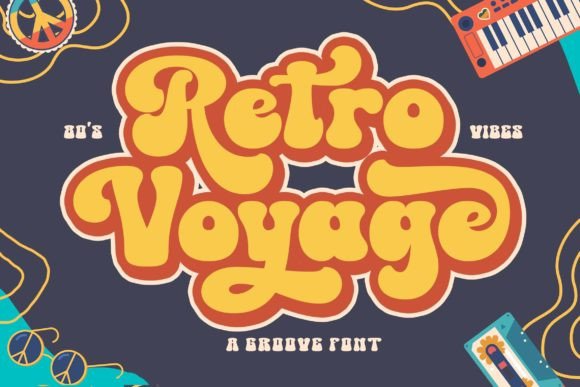
Retro Voyage: A Designer's Guide to This Groovy Script Font
There’s a particular warmth to 1970s and 80s design—the swooping lines of a muscle car, the confident loops of a concert poster, the casual elegance of a boutique logo. Capturing that feeling in a modern project often feels like chasing a ghost. You need a typeface that doesn’t just mimic the era, but embodies its confident, flowing energy. This is where Retro Voyage enters the scene. It’s not a dusty relic; it’s a carefully crafted script font designed to inject immediate personality and nostalgic charm into your work. Think of it as a premium font asset that brings the vibe of vintage hand-lettering directly into your toolkit, without the hassle of deciphering faded samples.
Understanding the Personality and Visual Style
At its core, Retro Voyage is a display font. Its strength lies in its distinctive, flowing cursive letterforms that evoke the smooth, optimistic aesthetics of its inspiration era. The characters connect with a natural, rhythmic flow, featuring moderate stroke contrast that keeps it legible while maintaining its groovy character. It’s not a formal serif font or a rigid sans serif font; it exists in that expressive space of handwritten fonts and script fonts, where each letter feels personally crafted. The overall appeal is one of friendly sophistication—it’s playful enough for a retro-themed party invitation yet polished enough for a boutique brand’s logo. This balance is its key strength, making it a versatile creative font for designers who need personality without sacrificing clarity.
Where Retro Voyage Truly Shines: Practical Applications
Knowing where to deploy a font like this is half the battle. Retro Voyage isn’t a workhorse for body text; it’s a strategic accent. Its ideal domain is in projects where you want to make an immediate emotional or stylistic statement. Consider these real-world scenarios:
- Logo Design and Brand Identity: For a craft brewery, a vinyl record store, a vintage clothing brand, or a specialty coffee shop, Retro Voyage can form the core of a memorable logo design. It instantly communicates a specific brand personality—retro, artisanal, and approachable. Pair it with a clean, geometric sans serif font for body copy to create a balanced and professional brand identity.
- Packaging Design: On product labels, especially for gourmet foods, cosmetics, or artisanal goods, this font adds a layer of curated, nostalgic appeal. It suggests a product with a story, crafted with care. The flowing script can guide the eye across a label, highlighting the product name while supporting details use a simpler typeface.
- Editorial and Publishing: In editorial design, use it sparingly for pull quotes, chapter titles, or feature headers in a magazine or book. It breaks the monotony of standard text, adding a moment of visual delight that can enhance reader engagement. It’s a tool for creating visual hierarchy.
- Digital and Social Media: For web design, think hero sections, special announcement banners, or styled headers for blog posts about vintage culture. For social media graphics, it’s perfect for creating eye-catching Instagram story templates, Pinterest pins, or Facebook post headers that stop the scroll with their retro flair.
- Print and Personal Projects: Beyond commercial use, it’s a fantastic asset for personal projects. Think custom wedding invitations, greeting cards, or crafting projects like custom apparel prints or decorative signage. Its commercial font licensing usually covers these uses, making it a valuable part of your design assets collection.
Making It Work: Readability, Pairing, and Professional Use
A beautiful font can fail if it’s used poorly. With Retro Voyage, the primary consideration is readability. Because it’s a script with connecting strokes, it should be used at larger sizes. At small sizes or in long paragraphs, the details can blur, hurting comprehension. Always test your design at the intended output size. For a website, check it on mobile screens. For print, do a physical proof.
Effective font pairing is crucial. Let Retro Voyage be the star. It naturally pairs well with neutral, structured fonts. A clean sans serif font like Futura or Helvetica provides a modern counterbalance. A simple, old-style serif font like Garamond can create a more traditional, refined feel. Avoid pairing it with other highly decorative or script fonts, as this creates visual competition and confusion. The goal is contrast and clarity.
When evaluating if it’s the right fit for your project, ask yourself: Does my project’s tone align with vintage, retro, or handcrafted aesthetics? Will the text be displayed at a size where its details are clear? Do I have a complementary font for longer text blocks? Check what styles are included—does the font family come with alternates, ligatures, or stylistic sets that offer more design flexibility? Finally, review the licensing. If you’re using it for a client’s logo or on merchandise sold commercially, ensure you have the appropriate commercial font license. This due diligence is what separates a hobbyist from a professional, ensuring your work is both beautiful and legally sound.
Retro Voyage offers a specific tool for a specific job. It’s not about replacing your entire modern typography system. It’s about having a reliable, expressive asset in your arsenal that can transport a design back in time with a single word. Used thoughtfully, it doesn’t just spell out a name—it tells a story, builds a recognizable aesthetic, and connects with an audience on an emotional level. That’s the real value of a well-chosen typeface.